North Star Framework
The North Star Framework, popularized by Amplitude, is a strategic approach to Product Management. The idea is to identify and track a single metric that serves as a leading indicator for business success. The playbook is accessible online and constantly updated.
Connecting the Dots
The overall idea of the North Star Framework (NSF) is to find a single leading indicator for future business success and connect all activities of the team with that indicator:
The heart of the North Star Framework is the North Star Metric, a single critical rate, count, or ratio that represents your product strategy.
In a nutshell, the idea is to:
-
Find a single metric, the North Star Metric, that acts as a leading indicator for the future success of the product. This is a metric that can be captured quickly and will drive the product strategy because it is, what the team believes, and what moves the needle.
-
Consider the North Star Metric supporting the long-term business goals. However, these are typically lagging indicators, so they are the business outcome and a consequence of the actions as driven by the North Star Metric. Typically, they are hard to influence directly.
-
Collect a handful set of Input Metrics that contribute to the North Star Metric but can be influenced directly by the product offering. For example, when a food delivery service had a North Star Metric like number of items received on time, then inputs might be:
- number of orders by customers
- number of items per order
- ratio of the fulfillment of orders, and
- in-time delivery of orders
-
Derive The Work in the sense of actual designs, prototypes, and product features to improve the Input Metrics.
The following illustration provides a rough overview:
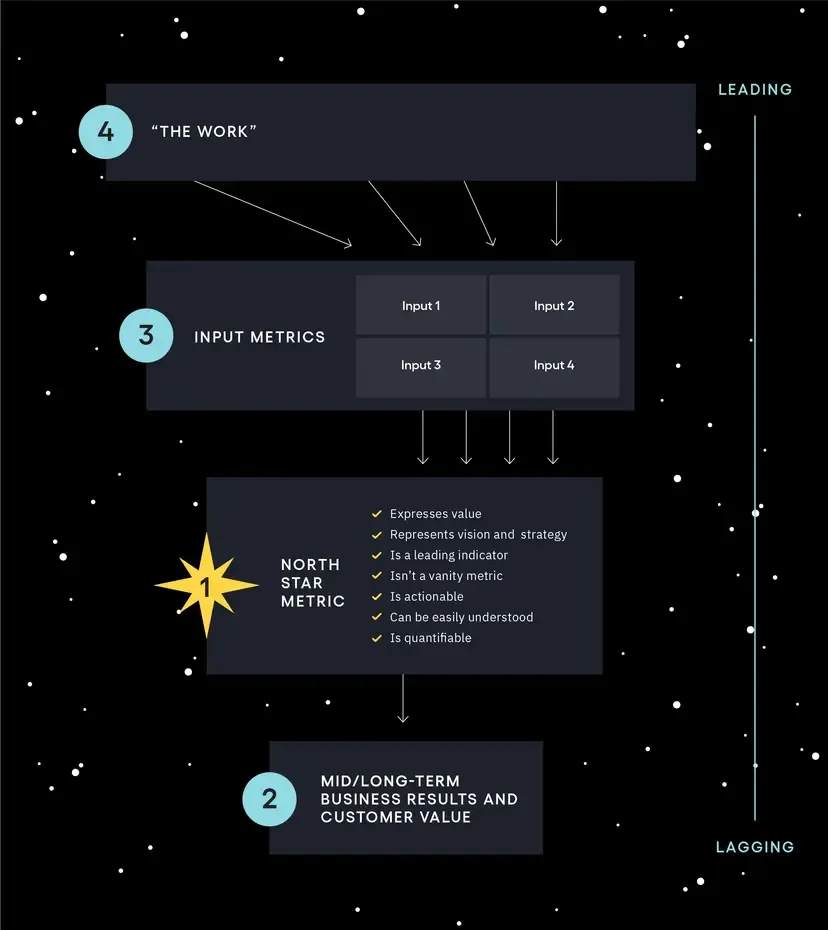
So, similarly to Impact Mapping, the North Star Framework tries to establish a holistic methodology to connect the dots — from long-term business goals down to features, tasks, and work items of teams.
Identifying a single North Star Metric is probably a key challenge here. At least in Enterprise B2B contexts when the user base is very heterogeneous. Also, it is a very data-driven approach, so for long sales cycles it might even be challenging to collect relevant metrics quickly enough to be actionable.