Competency Assessment
Product Management isn’t for everybody. And even when you stepped in, you may wonder how to further develop in order to build a successful career. On this page, we want to explain how Product Managers’ competencies can be assessed holistically and systematically.
The Product Management Competency Role Map
To provide guidance toward a long-term career as well as for coaching and developing team members, their tasks, skills, and competencies can be assessed along various dimensions. The following tables depict such a role map as we have been using it for more than a decade. While company-specific aspects need to be added, the role maps below have been anonymized so as not to disclose any confidential information. Still, the overall idea should become clear — specifically how required skills and accountability grow from more junior to more senior positions. The role map has been updated for AI-assisted product work. AI is not treated as a separate competency but as part of how each competency is practiced today. See Product Management in the Era of AI.
Know the Craft
As the first area of expertise, knowledge about the domain and the product comes top of all. If nothing else, a Product Manager has to know about the market the company is operating in, its customers, and its product offering. Of course, the tools of the PM trade are required, too, and today these include AI tools:
| Aspect | Content | Associate Product Manager | Product Manager | Senior Product Manager |
|---|---|---|---|---|
| Market expertise | Know the market and competition, understand trends | Willingness to learn quickly about the market, trends and competition | Good knowledge of the market with awareness of the competitive situation | Excellent understanding of market trends and competitive situation |
| Domain expertise | Be a domain expert | Talks to senior colleagues and domain experts to learn, builds an internal network of supporters and acquires domain knowledge step-by-step | Very good understanding of the domain, knows who to reach out for in case of more expertise required | Domain expert perceived as a thought leader, interacting with peers in the industry, at conferences etc. |
| Product expertise | Know the product inside out | Quickly learns about the general concepts of the product as well as the main application areas of the modules | Very good understanding in at least one area and good knowledge about the overall product | Excellent understanding of the product with expertise in one or more specific areas |
| Tool expertise | Master user stories, user journeys, JTBD, AI tools, … | Knows general PM tools and frameworks and is willing to learn how they are applied inside the company. Uses AI tools for research and drafting under guidance and verifies the output before passing it on. | Can apply PM tools and create content with the frameworks selected inside the team. Uses AI routinely across analysis, discovery, prototyping and documentation, knows where it is unreliable, and can stand behind every line it produces. | Expert in PM tools and processes, can guide others and bring new ideas; continuously learns new skills. Sets the standard for how the team works with AI, coaches others, and challenges results that are plausible but unverified. |
Product Discovery Skills
As a second dimension, understanding the Four Key Risks relevant to product development is key, and, hence, Product Discovery brings several skill requirements:
| Aspect | Content | Associate Product Manager | Product Manager | Senior Product Manager |
|---|---|---|---|---|
| Market research | Be able to eliminate value and viability risks | Can support senior colleagues in collecting data on the market, from that builds up their own skills. Uses AI for desk research and verifies key facts. | Can collect and organize market information guided by product leaders, starts creating their own assessments and aligns with leaders. Uses AI to collect and condense market and competitor information, checking key facts against primary sources. | Knows how to gather information about markets and target segments, can assess business value of new product initiatives |
| Quant & qual research | Be able to eliminate value and usability risks | Supports the team in running discovery and gathering insights, learns quickly how to eliminate product risks. Uses AI to transcribe and summarize interviews and to cluster customer feedback. | Guided by product leadership, actively participates in continuous discovery, collaborates with the UX research team and distills insights to eliminate product risks. Uses AI to synthesize interviews, tickets and usage data at scale, while keeping direct customer contact as the primary source of insight. | Initiates and drives customer research, participates in continuous discovery, distills insights and key learnings to eliminate product risks. Knows the limits of AI synthesis: decides which customers to talk to and looks for what the data cannot show. |
| Prototyping & testing | Be able to eliminate usability and feasibility risks with realistic, non-production prototypes | Supports the team, builds simple AI-assisted prototypes and runs smaller testing sessions independently, helps validate ideas to eliminate product risks | Guided by product leadership, builds clickable prototypes with AI tools and tests them with customers to validate ideas and eliminate product risks; treats prototypes as a means to learn, not as production code | Expert in various prototyping and testing techniques including AI-assisted prototyping, explores several candidate solutions quickly, guides research to validate ideas and eliminate product risks |
| Business viability | Be able to eliminate business viability risks | Understands the company’s mission, vision and objectives, helps more senior colleagues to gather data to assess business viability | Guided by product leadership, determines factors that indicate business value, is able to independently consider the company’s mission, vision and objectives in decision making | Knows how to assess business value of ideas in alignment with the company’s mission, vision and objectives |
Product Delivery Skills
After discovery, another set of skills refers to being able to develop ideas and drive the implementation of solutions:
| Aspect | Content | Associate Product Manager | Product Manager | Senior Product Manager |
|---|---|---|---|---|
| Ideation & solutions | Drive ideation to find solutions | Knows at least a few ideation techniques and is willing to learn more quickly, helps applying the tools across teams | Knows some ideation techniques and can collaborate with the entire team towards finding solutions. Uses AI to broaden the solution space before narrowing it down with the team. | Knows various ideation techniques, can pick the appropriate tools depending on context and guides the team towards finding suitable solutions |
| Planning & roadmapping | Plan features and align on an agile roadmap | Helps more senior colleagues to specify feature requirements, e.g. as shaping documents and prototypes, understands the nature of an agile roadmap | Can describe feature requirements in high quality, preferably as a lightweight shaping document plus prototype rather than a heavyweight specification, uses AI to draft and maintain documentation, and jointly with the team arranges an agile roadmap | Based on a mid-term vision, can describe feature requirements in high quality and plan by way of an agile roadmap. Keeps specifications and documentation lean and current with AI support. |
| Work with agile team | Collaborate with the team in agile processes | Helps to collaborate with the team, facilitates meetings and alignments, brings own ideas to push implementation forward | Supported by product leadership, collaborates with the team towards successful implementation, aligns internally across workstreams. Brings prototypes rather than documents into working sessions with engineering. | Shares vision & strategy, inspires the team and leads towards successful implementation, can run a complex workstream independently. Establishes collaborative working sessions in which product, design and engineering build on a prototype together. |
| Architecture / coding | Align with architecture, avoid tech debt, and keep prototypes separate from production code | Understands the nature of architecture and technical debt, helps to avoid and resolve by way of involving technical experts | Delegates architecture and technical alignment to technical experts; hands over intent and prototypes, while production code is built by engineering. May contribute small, low-risk UI changes as pull requests reviewed by engineering, never touching core APIs, performance or security. | Ensures alignment with technical requirements and architecture to avoid or overcome technical debt. May contribute small, low-risk UI changes as pull requests reviewed by engineering, never touching core APIs, performance or security. |
Launching a Product
Finally, when it’s time to release a product or feature, dedicated skills are required to ensure successful roll-out:
| Aspect | Content | Associate Product Manager | Product Manager | Senior Product Manager |
|---|---|---|---|---|
| Ship & launch | Release and launch, including communication | Understands concepts as “thinking backwards” and helps to organize demos and internal communication. Helps prepare launch material with AI support. | Launches new features, can demo internally, contributes to input for product marketing. Uses AI to prepare release notes, demo scripts and enablement drafts, and checks them for accuracy. | Launches new features and modules, can present in convincing demos and provide high-quality input for product marketing |
| Go-to-market | Plan land-and-expand as well as roll-out and migration | Supports the team in organizing roll-outs, developing migration strategies etc. | Guided by product leadership, considers roll-out of new functionality and aligns with Sales and Customer Success to ensure successful implementation of new features | Plans how new features and modules are delivered to customers, supports selling and helps winning new customers |
| Communication | Outbound communication, webinars, press releases etc. | Supports the team in internal communication, participate in presentations, act as the “mom tester” for the team | Very good communication skills, can present internally across all levels as well as on project level at customers | Excellent communication skills with the ability to present and communicate towards customers including their executives |
| Stakeholder management | Align with stakeholders and shareholders | Supports the team to arrange and prepare stakeholder alignment | Guided by product leadership, creates presentations to stakeholders and ensure alignment | Valued partner for all teams and stakeholders, helps to succeed across all departments |
Using the Role Map in Career Talks
The PM Role Map is straightforward to use in regular performance reviews:
-
To prepare for the career talk, the Product Leader distributes an up-to-date version of the role map and asks every team member for their self-assessment.
-
Both the Product Manager and the Product Leader prepare their assessment independently.
-
Laying both assessments side-by-side, discrepancies become immediately apparent, and the Product Manager and her manager can discuss opinions, identify gaps, and agree on the next steps to close these gaps.
-
For both the employee and her manager, the role map provides a fully transparent tool to discuss promotions and the skills needed for the next step in the career of a Product Manager.
We have been using this model for more than 20 years as leaders in product and technology. Of course, the actual content of the role map may vary. Often, company- or product-specific details will be added, which might easily result in 30-40 aspects to be discussed. This isn’t a problem at all if the role map is not seen as a form that has to be filled out pedantically accurately by both participants — but rather as a tool to align on the assessment and trigger discussions on diverging views or growth areas to focus on.
The Competency Wheel
The above PM Role Map is a tool to coach team members through their careers in Product Management. Sometimes, however, a more visual tool is needed to depict the current state of affairs and maybe also map out how different team members compare against each other — or how a candidate compares a target state, say, when discussing promotions.
For that, we can arrange the exact same competencies as described in the Role Map as a PM Competency 4×4 Wheel:
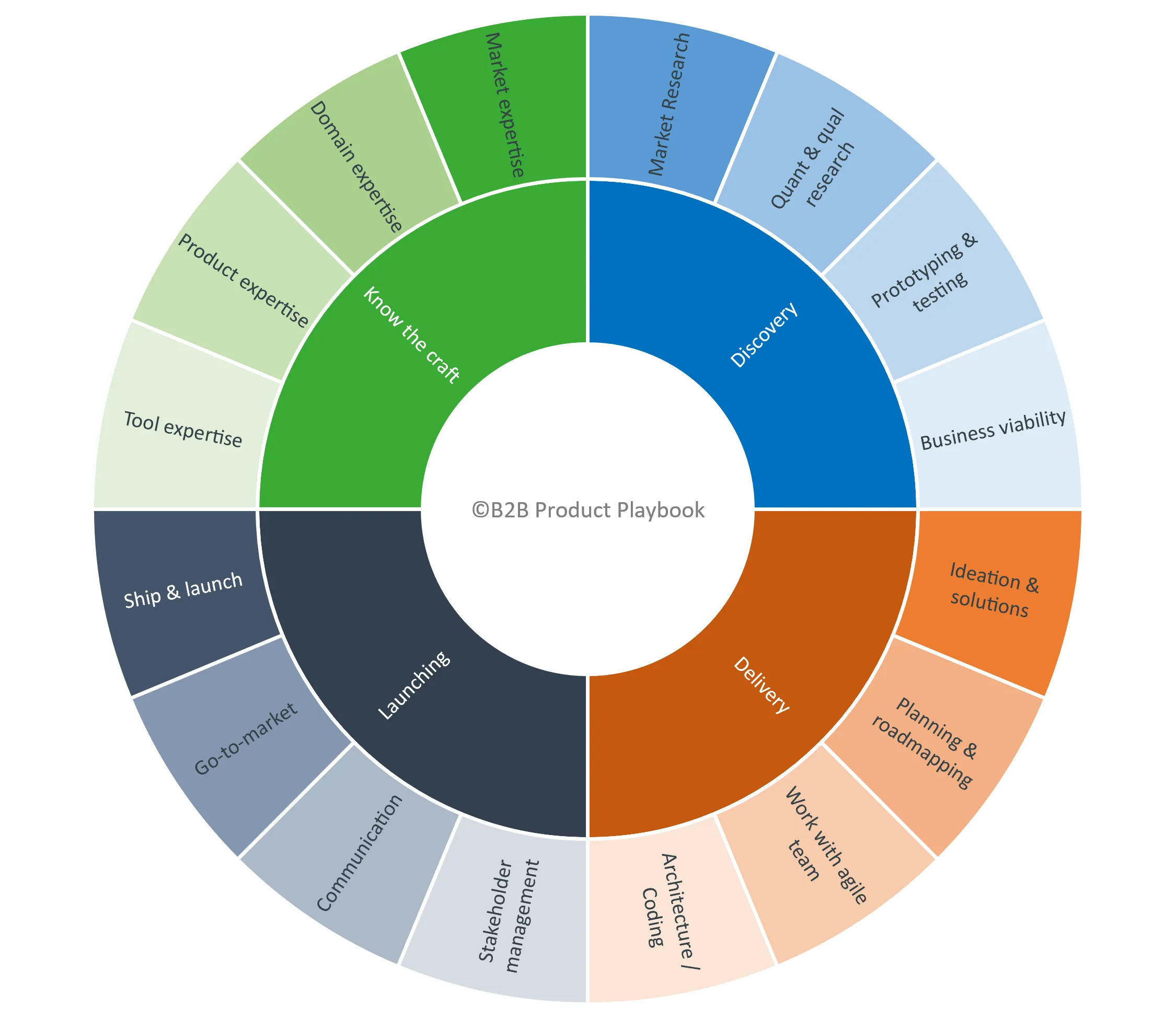
As can be seen easily, the inner circle reflects exactly the same categories that were used above to group the skills and competencies of Product Managers. At the same time, the outer ring lists the respective skills as explained above.
For example, the following are all part of discovery:
- Market research to learn about market sizes, growth rates, competition, etc.
- Quantitative & qualitative research to learn from user interviews and data
- Prototyping & testing to validate ideas
- And finally, research to ensure business viability
Being more visual than the tables above, the PM Competency 4×4 Wheel allows for some very nice and easy-to-grasp visualizations when comparing a team member against the requirements of the current position — or against those of the next position when a promotion is under discussion:
- Utilize a simplified scale, such as
- 1 = Cannot do
- 2 = Can do under supervision
- 3 = Can do independently
- 4 = Can guide others
- Rate each of the 16 skills in preparation for the career talk, precisely as described for the PM Role Map above.
- Display the results on a simple radar plot.
For example, the chart on the right does not depict a personal assessment (for obvious reasons) but instead the potential requirements of Associate PM (APM), PM, and Senior PM (SPM) with growing competence levels.
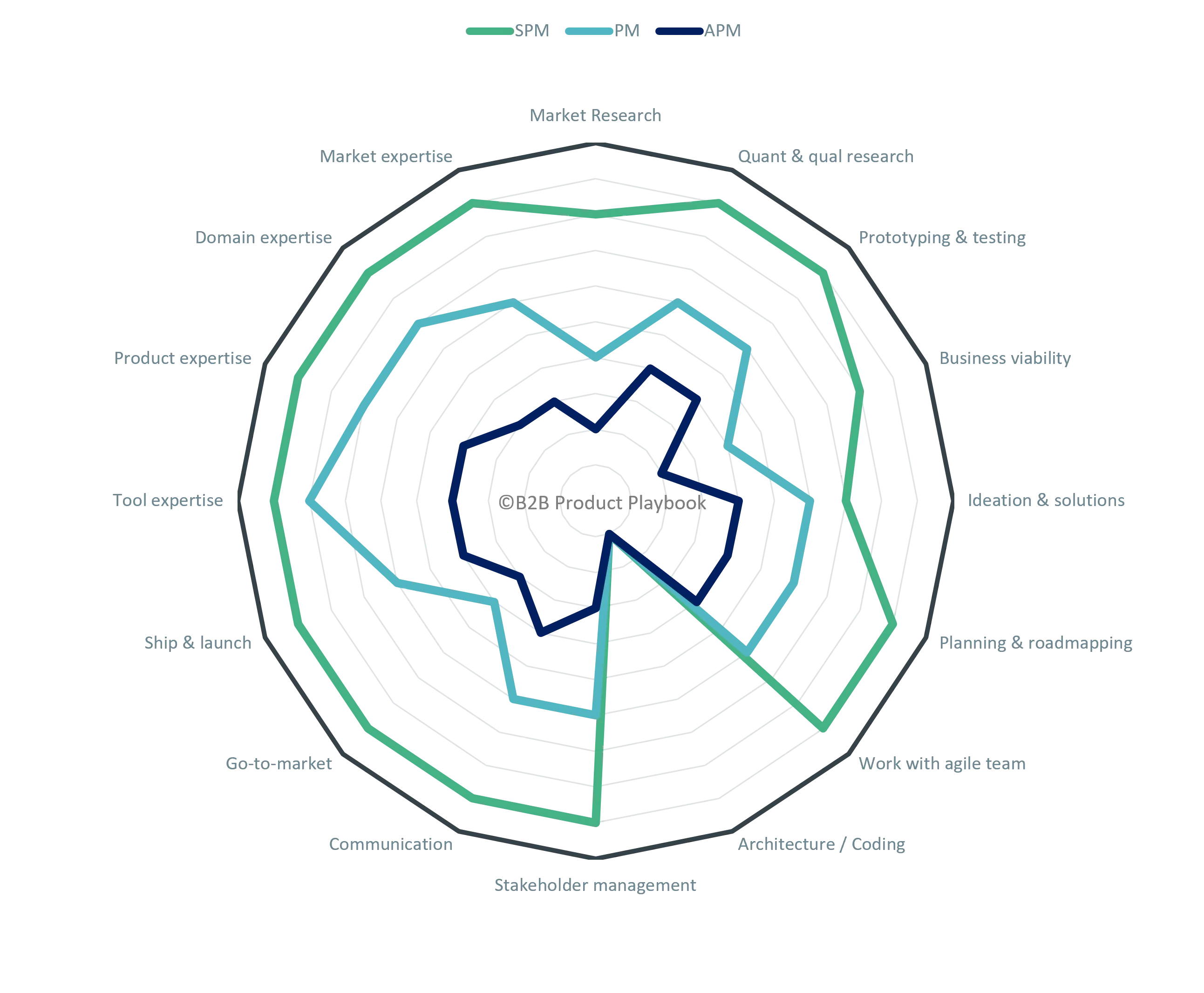
Thus, gaps and improvement areas of a Product Manager become immediately visible so that objectives and focus areas for the coming months can be agreed between the Product Manager and her boss.
A Step by Step Guide for Using the Model
Update: Upon popular request, we have decided to not only describe our method here but also make a ready-to-use template available for free via this resource page.
To benefit from the model the most, we recommend a quarterly cadence of 1:1 performance review meetings, which can be run as follows:
Explain the Model
Specifically, when the model is used for the first time, the Product Leader needs to explain its structure and content: What are the skills we aim for in the various dimensions, what do we mean, and how do we assess?
Assess the Status Quo
Let both, the product leader and the individual contributor assess the competency of the Product Manager independently from each other. As a result, each of them will come to the 1:1 performance review with their version of the radar plot sketched above.
Discuss and Align
During a 1:1, review both assessments, discuss, and align. It is crucial that you block sufficient time for that. This is not a quick 30-minute weekly. According to our experience, when running these 1:1 ca. quarterly, you might need 2 – 3 hours.
Watch out for Discrepancies
When discussing, specifically watch out for areas where both parties disagree significantly. Do not get obsessed about nuances, but when the Product Manager believes she can work on a task completely independently while the Product Leader sees the need for constant supervision – then you have a mismatch. (By the way, also the other way around when the Product Manager does a great job but shows a lot of self-doubts.)
Detect Gaps toward Next Step
Thinking about the next career steps of the Product Manager, look for gaps. Here, the radar plot is handy as it often displays that gap in a highly visual manner.
Select a Focus Area
Rome wasn’t built in a day. So, select some areas to focus on in the coming period. If that is a period of just a few months, don’t set goals too high but remain realistic. We have made good experiences focusing on one quadrant of the 4×4 wheel.
Agree on SMART Goals
Finally, for these focus topics, define SMART goals so that when you meet again in a few weeks or months, you can track progress.